Dermorphin (Tyr-D-Ala-Phe-Gly-Tyr-Pro-Ser-NH2) is a naturally occurring heptapeptide isolated from the skin of South American Phyllomedusa frogs — the first naturally occurring peptide identified as a highly potent and selective super-agonist at the mu opioid receptor (MOR), with approximately 100-fold higher MOR affinity than morphine.
Dermorphin is one of the most pharmacologically distinctive opioid research peptides in the published literature — notable for its D-amino acid configuration at position 2 (D-Ala2), which is unique among naturally biosynthesised animal peptides and is essential for its extraordinary MOR selectivity and potency. Dermorphin and its analogues have been pivotal reference compounds in mu opioid receptor binding characterisation, SAR-based opioid drug design, and affinity label development for MOR across more than four decades of published research. Each batch is independently quality-tested and distributed in a controlled lyophilised format for precise laboratory handling.
What is Dermorphin?
Dermorphin is a heptapeptide amide with the sequence Tyr-D-Ala-Phe-Gly-Tyr-Pro-Ser-NH2, first isolated by Erspamer and colleagues from the skin of the South American tree frog Phyllomedusa sauvagei in 1981. It belongs to a family of amphibian skin-derived opioid peptides — a group that also includes the related deltorphins — that share a characteristic N-terminal Tyr-D-aa-Phe ‘message’ domain structure responsible for opioid receptor binding. However, dermorphin is structurally unlike any mammalian opioid peptide: it shares no common sequence with endorphins, enkephalins, or dynorphins, and contains a D-amino acid (D-Ala2) in its native structure — a feature that is exceptionally rare in naturally biosynthesised animal proteins and peptides.
The presence of D-Ala at position 2 is not incidental — it is structurally critical to dermorphin’s pharmacological profile. Studies directly comparing dermorphin with its all-L-amino acid counterpart ([L-Ala2]dermorphin) have confirmed that the D-configuration at position 2 is essential for high-affinity MOR binding and biological activity. The synthetic [L-Ala2] variant showed very low affinity for opioid receptors in rat brain preparations — an affinity that was not meaningfully restored even in the presence of peptidase inhibitors — establishing that the D-Ala2 residue provides the correct three-dimensional conformation required for productive MOR engagement rather than simply conferring metabolic stability.
Dermorphin’s structure follows the ‘message-address’ model of opioid peptide-receptor interaction — a framework established through extensive SAR studies using dermorphin as a primary template. The N-terminal Tyr-D-Ala-Phe tripeptide constitutes the ‘message’ domain responsible for receptor activation, while the C-terminal Gly-Tyr-Pro-Ser-NH2 tetrapeptide constitutes the ‘address’ domain that confers receptor subtype selectivity. This pharmacophore framework, first defined through dermorphin SAR research, has since guided the design of numerous opioid receptor ligands across the broader medicinal chemistry literature.
Dermorphin – Key Research Facts
- Sequence: Tyr-D-Ala-Phe-Gly-Tyr-Pro-Ser-NH2 (heptapeptide amide)
- Source: Naturally isolated from skin of South American Phyllomedusa sauvagei frog — first reported 1981
- Receptor: Highly selective mu opioid receptor (MOR) super-agonist — approximately 100-fold higher MOR affinity than morphine
- Unique structural feature: D-Ala at position 2 — rare example of a D-amino acid in a naturally biosynthesised animal peptide
- D-Ala2 function: Essential for MOR binding conformation and biological activity — not merely a metabolic stabilising feature
- Pharmacophore model: ‘Message-address’ framework — N-terminal Tyr-D-Ala-Phe = MOR activation message; C-terminal Gly-Tyr-Pro-Ser-NH2 = receptor subtype selectivity address
- MOR selectivity: Among the most selective naturally occurring MOR agonists known — selectivity ratio (Ki delta/Ki mu) documented at levels far exceeding conventional opioid reference compounds
- Research significance: Primary SAR scaffold for MOR-selective opioid peptide drug design; foundational ligand for dermorphin-based affinity label and probe development
- Dermorphin gene: Encoded in Phyllomedusa sauvagei skin cDNA — same gene locus also encodes the delta-selective dermorphin gene-associated peptide (DGAP)
What Does Dermorphin Do in Research?
In laboratory and pre-clinical research settings, Dermorphin serves as the primary naturally occurring, highly selective MOR agonist reference peptide for mu opioid receptor binding, pharmacology, and SAR studies. Its exceptional MOR selectivity — substantially exceeding that of conventional opioid reference compounds such as DAMGO in published receptor binding assays — makes it a uniquely valuable tool for research requiring high-confidence, selective MOR engagement without the receptor cross-reactivity that complicates interpretation of studies using less selective opioid ligands.
Dermorphin binds to MOR through its N-terminal ‘message’ tripeptide (Tyr-D-Ala-Phe), engaging the orthosteric binding pocket and activating the receptor’s Gi/o protein coupling — inhibiting adenylyl cyclase, reducing intracellular cAMP, activating inwardly rectifying potassium channels (GIRK channels), and inhibiting voltage-gated calcium channels. These downstream signalling events collectively reduce neuronal excitability in MOR-positive cell populations. Dermorphin’s C-terminal ‘address’ domain contributes additional selectivity determinants that position the peptide as a highly effective reference agonist for distinguishing MOR-mediated signalling events from delta opioid receptor (DOR) or kappa opioid receptor (KOR) contributions in mixed-population assay systems.
Beyond receptor binding and classical opioid signalling studies, dermorphin has been used extensively as the parent scaffold for the development of MOR-selective affinity labels — covalently-binding probes that enable irreversible receptor occupation for receptor distribution mapping, receptor-ligand contact point identification, and receptor purification applications. Dermorphin-based affinity labels with subnanomolar to nanomolar IC50 values have been reported as the highest-affinity peptide-based affinity labels for MOR described in the published literature to date. Dermorphin has also been the scaffold for development of the DALDA peptide series (D-Arg2, Lys4 analogues), which have been studied for their extraordinary peripheral MOR selectivity due to their high net positive charge.
Key Research Areas for Dermorphin
- Mu opioid receptor (MOR) binding kinetics, selectivity profiling, and competitive displacement assays
- MOR orthosteric binding pocket characterisation — receptor-ligand contact point mapping via affinity label derivatives
- Gi/o protein coupling, cAMP inhibition, GIRK channel, and calcium channel signalling studies downstream of MOR activation
- Structure-activity relationship (SAR) research — message domain, address domain, and D-amino acid positional studies
- MOR-selective affinity label development — dermorphin-based irreversible probes for receptor distribution and purification
- Comparative MOR selectivity studies — dermorphin vs. DAMGO, morphine, beta-endorphin, and enkephalin reference compounds
- Central mu opioid receptor-mediated renal function pathway studies — diuresis, natriuresis, and ADH-independent sodium handling
- DALDA series research — peripheral MOR selectivity via cationic dermorphin tetrapeptide analogue studies
- Opioid receptor subtype discrimination studies — MOR vs. DOR vs. KOR binding profile characterisation
- Radioligand binding — [3H]dermorphin receptor autoradiography and brain MOR distribution mapping
- D-amino acid pharmacology — investigation of D-aa2 conformation requirements for MOR binding across the opioid peptide class
What Do Studies Say About Dermorphin?
Dermorphin has a well-established published research base spanning its initial discovery, receptor pharmacology characterisation, SAR-based analogue development, affinity label synthesis, and central MOR-mediated physiological studies.
Foundational MOR Characterisation — Super-Agonist Profile & Brain Distribution (PubMed, 1990)
Dermorphin as the First Naturally Occurring Highly Potent and Selective MOR Super-Agonist
A comprehensive pharmacological characterisation study published on PubMed undertook a complete evaluation of dermorphin’s receptor selectivity, binding characteristics, and brain receptor distribution using [3H]dermorphin radioligand studies. The study confirmed dermorphin as the first naturally occurring peptide to be identified as a highly potent and nearly specific super-agonist at the morphine (mu) receptor. Receptor autoradiography confirmed that the distribution pattern of [3H]dermorphin binding sites in rat brain paralleled that observed using other established mu probes, and binding parameters and selectivity profiles on slide-mounted sections were consistent with membrane homogenate results — validating [3H]dermorphin as a reliable MOR radioligand for brain receptor mapping. Intracerebroventricular administration in mice confirmed dermorphin as the most potent analgesic peptide known at the time, reported as up to 5 times more active than beta-endorphin and approximately 670 times more active than morphine in equivalent in vivo assay conditions.
Reference: Gacel G et al. (1990). Characterisation and visualisation of [3H]dermorphin binding to mu opioid receptors in the rat brain. British Journal of Pharmacology. PubMed PMID: 2161761.
D-Ala2 Residue — Essential for MOR Binding Conformation (PubMed, 1987)
[L-Ala2]Dermorphin Demonstrates That D-Configuration at Position 2 is Structurally Critical
A binding study published on PubMed directly assessed the importance of the D-Ala2 residue in dermorphin by comparing the MOR binding of native dermorphin (D-Ala2) against its synthetic all-L-amino acid counterpart [L-Ala2]dermorphin in rat brain opioid receptor preparations using [3H]naloxone competitive binding. [L-Ala2]dermorphin showed very low affinity for opioid receptors — an affinity that was only slightly increased even when peptidase inhibitors (bestatin alone and in combination with captopril and thiorphan) were added to protect against metabolic degradation. The low affinity was not restored even at 0°C, ruling out simple metabolic susceptibility as the explanation. The authors concluded that the D-Ala2 residue is essential for productive MOR binding and pharmacological activity — providing the three-dimensional conformation required for the message domain to engage the orthosteric binding pocket.
Reference: Melchiorri P et al. (1987). Binding studies of dermorphin and its L-form on rat brain opioid receptors. Regulatory Peptides. PubMed PMID: 3035583.
DALDA Series — Peripheral MOR Selectivity via Cationic Dermorphin Analogues (PubMed, 1989)
Membrane Compartment Model: Positive Charge Drives Unprecedented Mu Receptor Selectivity
A medicinal chemistry study published on PubMed designed and evaluated a series of dermorphin analogues bearing increasing net positive charges to test the membrane compartment model of opioid receptor selectivity — the hypothesis that mu- and delta-receptors are located in anionic and cationic membrane compartments respectively, predicting that positively charged ligands should display enhanced MOR selectivity. A series of dermorphin tetrapeptide analogues carrying net charges of 1+, 2+, and 3+ were synthesised and evaluated in MOR and DOR binding assays. The most selective compound, [D-Arg2,Lys4]dermorphin-(1-4)-amide (DALDA), achieved a selectivity ratio of Ki(delta)/Ki(mu) = 11,400 — more than 10 times higher than the conventional MOR reference compound DAGO (selectivity ratio 1,050) — described as displaying unprecedented mu-receptor specificity. DALDA’s high positive charge (3+) was noted as making it particularly useful for studying peripheral MOR interactions owing to its restricted CNS penetration.
Reference: Schiller PW et al. (1989). Dermorphin analogues carrying an increased positive net charge display extremely high mu opioid receptor selectivity. Journal of Medicinal Chemistry. PubMed PMID: 2537427.
Dermorphin-Based MOR Affinity Labels — Subnanomolar Covalent MOR Probes (PMC, 2009)
Highest-Affinity Peptide-Based Affinity Labels for MOR Developed Using Dermorphin Scaffold
A study published in PMC developed a series of dermorphin-based electrophilic affinity labels — containing either bromoacetamide or isothiocyanate reactive groups — with IC50 values of 0.1–5 nM at MOR, described as the highest-affinity peptide-based affinity labels for MOR reported in the literature at the time of publication. All four analogues exhibited wash-resistant inhibition of [3H]DAMGO binding at subnanomolar to nanomolar concentrations, confirming covalent MOR binding. Modifications in the ‘address’ domain (positions 5–7) were well tolerated, maintaining nanomolar MOR affinity, while modifications in the ‘message’ domain (position 3, Phe3) resulted in >1000-fold reductions in affinity — directly confirming the critical role of the message domain in MOR engagement and validating the message-address pharmacophore model for dermorphin-MOR interaction. The study confirmed dermorphin’s 100-fold higher affinity for MOR compared to morphine as the basis for its utility as an affinity label scaffold.
Reference: Aldrich JV et al. (2009). Discovery of Dermorphin-Based Affinity Labels with Subnanomolar Affinity for Mu Opioid Receptors. Journal of Medicinal Chemistry. PMC Article PMC2788677.
Central MOR-Mediated Renal Function — Dermorphin as a Pharmacological Tool (PubMed, 1993)
Intracerebroventricular Dermorphin Reveals Independent Mechanisms for Renal Water and Sodium Handling
A pharmacological study published on PubMed used intracerebroventricular (i.c.v.) dermorphin as a selective central MOR agonist tool to dissect the independent central opioid mechanisms governing renal water and sodium excretion in conscious rats. I.c.v. dermorphin (0.1 nmol/kg) produced an increase in urine flow rate and a sustained decrease in urinary sodium excretion — responses completely prevented by pretreatment with the selective MOR antagonist beta-funaltrexamine, confirming MOR-mediated specificity. Importantly, dermorphin’s renal effects were reproduced in renal denervated rats, demonstrating that the antidiuretic and antinatriuretic responses are not mediated via central-induced changes in renal sympathetic nerve activity or renal haemodynamics. The authors concluded that central MOR agonists exert independent effects on renal tubular sodium reabsorption via mu opioid receptor-mediated mechanisms independent of renal innervation — using dermorphin’s MOR selectivity as the pharmacological tool that enabled this mechanistic dissection.
Reference: Kapusta DR, Obih JC, Dibona GF (1993). Central mu opioid receptor-mediated changes in renal function in conscious rats. Journal of Pharmacology and Experimental Therapeutics. PubMed PMID: 8097241.
Dermorphin Gene — Delta-Selective DGAP Co-encoded on the Same Gene (PubMed, 1989)
The Dermorphin Gene Encodes Both a MOR-Selective and a DOR-Selective Opioid Peptide
A study published on PubMed identified a cDNA sequence in Phyllomedusa sauvagei skin encoding both dermorphin and a newly identified heptapeptide designated dermorphin gene-associated peptide (DGAP). While dermorphin exhibits a MOR selectivity ratio (SR) of approximately 0.0055 — comparable to the conventional MOR reference DAMGO — synthetic DGAP and its [D-Met2] analogue showed a strikingly different receptor profile: [D-Met2]DGAP had an IC50 of 0.80 nM at delta opioid receptors and greater than 1 µM at MOR, yielding a delta selectivity ratio of 1,345. This finding — that a single frog skin gene encodes both one of the most MOR-selective and one of the most DOR-selective opioid peptides described — was described by the authors as potentially providing new insight into the design of future opioid receptor agonists and antagonists, and confirmed dermorphin as the MOR-selective reference arm of a paired mu/delta receptor research tool.
Reference: Lazarus LH et al. (1989). Dermorphin gene sequence peptide with high affinity and selectivity for delta-opioid receptors. Journal of Biological Chemistry. PubMed PMID: 2563375.
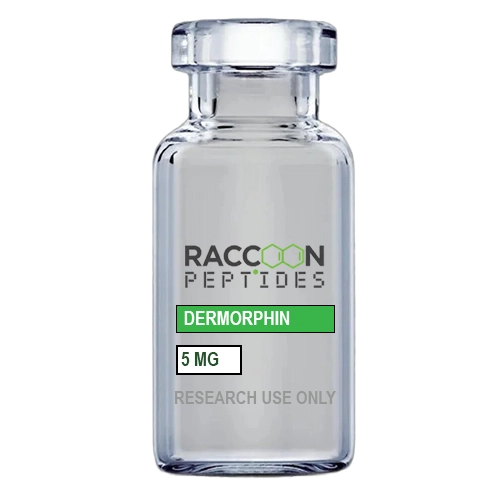
Dermorphin UK – Specifications
Product Details
- Sequence: Tyr-D-Ala-Phe-Gly-Tyr-Pro-Ser-NH2 (heptapeptide amide)
- Purity:>99% (HPLC verified)
- Form: Lyophilised powder
- Storage: Store dry at –20°C; protect from light
- Solubility: Sterile water, bacteriostatic water, or suitable laboratory buffer
- Distributed by: Raccoon Peptides
- Quality assurance: Rigorous batch-level analysis; certificate of analysis available on request
Research Applications
Suitable Laboratory Uses for Dermorphin
- MOR binding kinetics — Ki determination, competitive displacement, and selectivity ratio profiling vs. DOR and KOR
- MOR orthosteric binding pocket characterisation — radioligand ([3H]dermorphin) and fluorescent probe studies
- Gi/o protein coupling, cAMP inhibition, GIRK channel, and calcium channel downstream signalling studies
- Structure-activity relationship (SAR) investigations — message domain, address domain, and D-amino acid positional modification studies
- MOR-selective affinity label development — dermorphin parent scaffold for covalent MOR probe synthesis
- Comparative MOR selectivity studies — dermorphin vs. DAMGO, morphine, and beta-endorphin reference comparisons
- Opioid receptor subtype discrimination assays — MOR vs. DOR vs. KOR binding profile investigations
- Central MOR-mediated renal and cardiovascular pathway research using i.c.v. application models
- DALDA series pathway studies — peripheral MOR selectivity and membrane compartment model investigations
- D-amino acid pharmacology and conformation-activity relationship studies across the opioid peptide class
- Molecular analysis and controlled laboratory experiments


Please complete your information below to login.
Sign In
Create New Account